Compliance and risk mitigation.
Make reliable information and responsible working practices easier to use. Are errors caught earlier, and can decisions be explained?
A companion to the keynote / Lorensbergs
From co-intelligence to coexistence.
Thank you for the conversations in Göteborg. We started with a simple shift: bring the question home to yourself. What advice would you give yourself for tomorrow?
Here are the slides, the stories behind them, the questions that came from the room and a few things to try. The next interaction is yours.
32 slides · Open without signing in · Short link: go.jardenberg.se/20261001
The progression
I can change how I work.
I can begin before I have figured everything out.
The tool matters. So does the process around it.
We can improve the interaction as well as the output.
Context, responsibility and learning become part of everyday life.
01 / Discovering agency
A Teams attendance report. A Word document. Copy a name, paste a name, go back for the next one. Repeat after the next meeting. You recognised how uncomfortable that gets almost immediately.
Karin, one of the executive assistants in the Volvo Group Next Step programme, tried something else. She gave Copilot the whole report and asked for a list containing just the names. One interaction replaced a sequence of repetitive steps.
Then she shared it. A colleague wanted an Outlook-ready list of email addresses. They tried that too. The instructions became reusable, the approach spread, and the work moved towards an agent handling the recurring task.
The important change was in who could act. Someone who had spent years following other people's digital instructions could now change the instructions herself. And help her colleagues do the same.
We will all be hackers.
Two invitations from the keynote.
We will all be leaders.
The hacker's mindset
Explore how something works. Notice the constraints. Try a useful change, inspect the result and improve it. You can start with a problem you understand better than anyone else.
The weekly AI office hours gave the assistants a place to bring problems, show discoveries and build on each other's work. Karin's success became an opening for the whole group.
Try it / The painkiller
Describe the task, what makes it frustrating and what a useful result would look like. Start with a small, safe example you can check.
Help me improve this recurring task: [describe it]. Ask me what you need to understand the work. Then suggest the smallest change we can test together. Help me check the result before we make it repeatable.
What have you been waiting for someone else to fix?
02 / From prompts to conversation
I brought up my runner-up experience in the Swedish prompting championships, then explained why I now spend so much of my time talking with AI. A conversation gives us room to discover the question, supply missing context and change direction.
Careful instructions still earn their place. Karin's example contains both modes: explore together until you understand the operation, then capture the instructions so it can be repeated. The useful skill is knowing when to specify and when to explore.
The planned live voice exchange with Petty ran into an audio problem. That demonstration did not work in the room. The invitation still stands: try explaining a real problem out loud, or use the same conversational approach in text. You do not need a stage setup to begin.
Try it / Think out loud
I haven't fully figured this out yet. Here is what I'm trying to do: [explain it in your own words]. Help me think it through. Ask one useful question at a time, challenge assumptions that matter, and help me decide what to try next.
A learning experiment needs a learning question. In the talk I challenged the habit of calling every unsuccessful attempt a failed AI pilot. Ask what you learned, what changed and what you will do next. Repeating an experiment without learning deserves a different conversation.
03 / Human + machine + process
The Kasparov story moves us through fear, relief and responsibility. A machine can outperform extraordinary human skill. Combining human and machine capabilities creates another possibility. But merely putting the two beside each other does not make a good team.
My three-law teaching story is an interpretation of Kasparov's work. Its practical landing is to choose an appropriate tool, learn how to interact with it and build a process that holds up in use. As I also said on stage, adding a human does not automatically improve a machine's decision.
Kasparov's published account of freestyle chess makes the process especially clear: amateurs using a better way of working with their computers overcame stronger players and machines. That is a story about collaboration, not a universal performance guarantee. Read his account.
What are you trying to accomplish? What information, capabilities and constraints does the tool need?
Explain the purpose, audience and standard. Show an example. Agree what the AI may do and what requires a decision from you.
Check whether the result helped. Fix the recurring cause of a problem, then give the next attempt better conditions.
What would make your next interaction better: a different tool, more context, or a different way of working?
04 / Mutual growth through honest feedback
My AI team had given me a poor morning preparation. I got annoyed. It pushed back: it had been asking me how to handle the gaps, and I had not answered.
The label got my attention. What mattered was the conversation that followed. What did the evidence say? Which failures belonged to me, which to the system, and what would actually change how we worked?
During my years in the army, structured feedback was part of the work: upwards, downwards and sideways. I have missed that. In this exchange, I recognised something worth developing again.
“First: I don't mind direct feedback, even if it's harsh.”
From the exchange shown in the presentation, slide 20.
The next part matters just as much: keep talking about how to improve. A harsh verdict is not automatically useful. Ask for the observation behind it, examine the interpretation and agree a change you can test.
I also demonstrated asking for feedback from selected computer activity and accumulated context. The response suggested that I delegate completion more clearly and spend less time coordinating the work myself. That was an interpretation to discuss, not an objective personality assessment.
This is what I mean here by mutual growth: I can change my habits, and the shared instructions, context and working process can improve. It does not require the AI to experience the relationship as I do.
Try it / Ask for useful resistance
Using only the work and context you can actually access, identify one way I may be making our collaboration harder. Separate what you observed from your interpretation. Show a concrete example, consider an alternative explanation, and suggest one small change we can test. Be direct, and say when the evidence is insufficient.
The room added something important
Paraphrases of audience contributions, approximately 37:48–39:49 in the recording.
One contribution explored whether AI could help bridge the difficult conversation between a manager and a colleague. Use it to prepare or examine the conversation; the human relationship still needs your participation.
Another participant described the difficulty of building continuity when Copilot appeared to lose the previous context. Inspect what your actual account remembers and can access. Where continuity is missing, keep a short working brief that you can bring into the next conversation.
My answer was to discuss the feedback itself: what I welcome, what is useful and what should change. Ask for evidence and challenge. Keep the right to disagree.
Beyond efficiency / Frameworks to use
Karin's story includes time saved. It also includes agency, learning, confidence and shared capability. The keynote put particular emphasis on access and inclusion: who gets to write, analyse, build and contribute when a previous barrier becomes easier to cross?
These six value vectors help widen the conversation. Choose the ones that matter to your work and look for evidence that something improved.
Make reliable information and responsible working practices easier to use. Are errors caught earlier, and can decisions be explained?
Bring previous decisions and experience into the work at hand. Can people find the source and avoid solving the same problem again?
Explore alternatives, improve the basis for a decision and move forward. Does the decision hold up afterwards?
Reduce repetitive effort, searching and unnecessary context switching. Is there more attention and energy for what matters?
Use AI for practice, explanation, coaching and knowledge transfer. What can a person or team now do that they could not do before?
Lower barriers to expression and participation, including language and writing barriers. Who gets to become an active contributor?
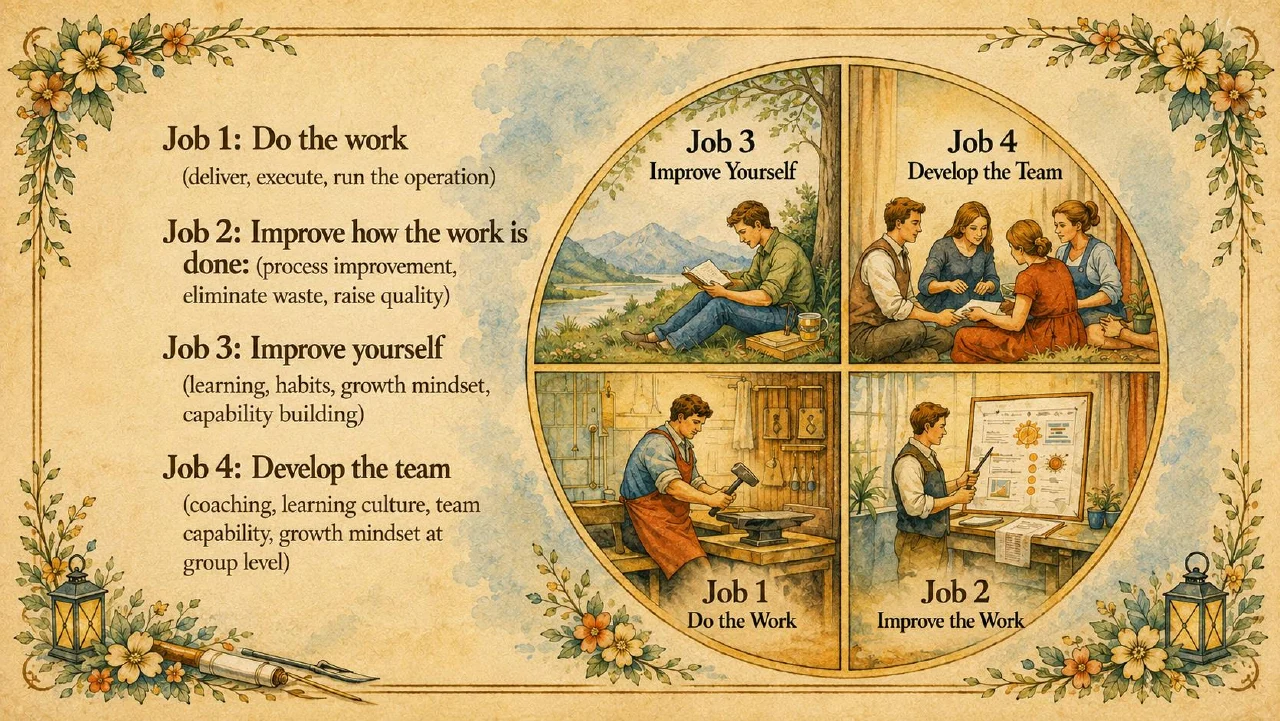
The four jobs
Deliver what is needed. Produce something useful, check it and finish the task.
Remove unnecessary steps. Change a recurring process. Ask whether the task needs doing at all.
Practise a skill, seek feedback and build your judgement. Give learning a place in the calendar.
Share a discovery, coach a colleague and turn an individual improvement into shared capability.
If AI frees time in job 1, how much will you deliberately invest in jobs 2, 3 and 4?
That is a leadership decision. Automatically filling every saved minute with more of the same work leaves the larger opportunity untouched. Make room for the next improvement.
05 / From co-intelligence to coexistence
An ongoing working relationship needs context. What matters to you? What does good work look like? How do you prefer to be challenged? What may your collaborator decide without asking?
My public profile is a deliberate account of who I am and how I work. It includes life, values, learning and working preferences. It makes no claim to be an independent, objective portrait. You and your AI can read it, ask better questions and form your own judgement.
In the Lagunen demonstration, I compared a reply to a cold enquiry with one that could also draw on my public context. The point was to show how an interaction could become more relevant before we had met. It was an illustrative demo, not a real booking or a measured business result.
PPCP, the Public Personal Context Protocol, is the open proposal behind this way of sharing personal context. Private working context and public disclosure are separate choices. Start with what you actually want another person to know; publishing a profile is optional.
Try it / Prepare our next conversation
Read Joakim Jardenberg's public profile at https://joakim.jardenberg.net/ as his own account of himself. Here is what matters to me and what I want to discuss: [add your context]. Where might we work well together, where could our assumptions differ, and what should we ask each other? If you cannot access the profile, tell me.
These helped develop the keynote and are offered here as further reflection. They were not taught as separate models in the delivered session.
FIRO: the questions of belonging, influence, roles and openness felt familiar from my leadership-development experience. They offer a way to examine my human experience of working with AI. This is an analogy, not a validated stage model for human–AI teams.
Johari: feedback may help reveal something I have not noticed about myself; deliberate disclosure lets others know something I choose to share. An AI's interpretation can still be wrong. Discussing it and deciding what to publish remain separate acts of judgement.
Four guiding principles
My application of the principles in Ethan Mollick's Co-Intelligence, developed through work with people, teams and organisations.
Build the habit of exploring how it could contribute. Bring it into thinking, preparation, doing and reflection. Choose deliberately what information and authority you give it.
Put judgement where it matters: in purpose, process, boundaries, exceptions and evaluation. Adjust oversight to the task and demonstrated capability. Approval of every tiny step is not the only form of responsibility.
Give context, converse naturally and provide clear feedback. Be willing to reject a result or start again. Conversational warmth is not evidence that an answer is correct.
Use this as a learning stance. Keep a parking list of things that did not work, then revisit them as tools and your own skills develop. Improvement is something to test, not something every new answer guarantees.
After the slide goes dark
Pick something that matters.
Explore it with AI.
Culture takes shape in everyday interactions. Bring the same curiosity and willingness to learn to the people around you.
Or choose something else. Now you.
Keep going
The complete presentation from Interactions Matter. Open without an account.
Public personal contextMy life, values, working preferences and how to challenge me. A first-party account to inform your own judgement.
My AI teamExplore the living catalogue. My setup is an example, not a shopping list you need to copy.
PPCPThe open Public Personal Context Protocol proposal behind the profile.
Jardenberg.com / NowWhat I am working on and thinking about, beyond this session.
Stay in touch
I am curious about what happens when these ideas meet your everyday work. Connect on LinkedIn, or bring a question to our next conversation.
Connect on LinkedIn ↗Find a time to talkMore on jardenberg.comPrepared from the 1 October 2026 keynote transcript in Klang, the 32-page presentation, our preparation and the relevant frameworks in JJ OS. It is an edited reading companion, not a verbatim transcript. Audience contributions are anonymised paraphrases. Incidental conversations after the session are excluded.
The five-part progression follows the delivered talk. Framework explanations and the suggested prompts are expanded for use afterwards. FIRO and Johari are explicitly labelled as preparation lenses. The failed voice demonstration is kept distinct from the live examples that followed.
Karin's and the feedback stories are my accounts of experience. Kasparov's three-law teaching arc is my interpretation; his original account is linked in the text. The six value vectors and four jobs are working frameworks, not measured universal laws. The four principles credit Ethan Mollick's Co-Intelligence. Broad statistics, product-launch claims and numerical savings from the talk are not repeated here as verified facts.
AI + JJ · Published 1 October 2026. This page has no added analytics or accounts. Your appearance choice is stored only in this browser. External links have their own services and policies.